
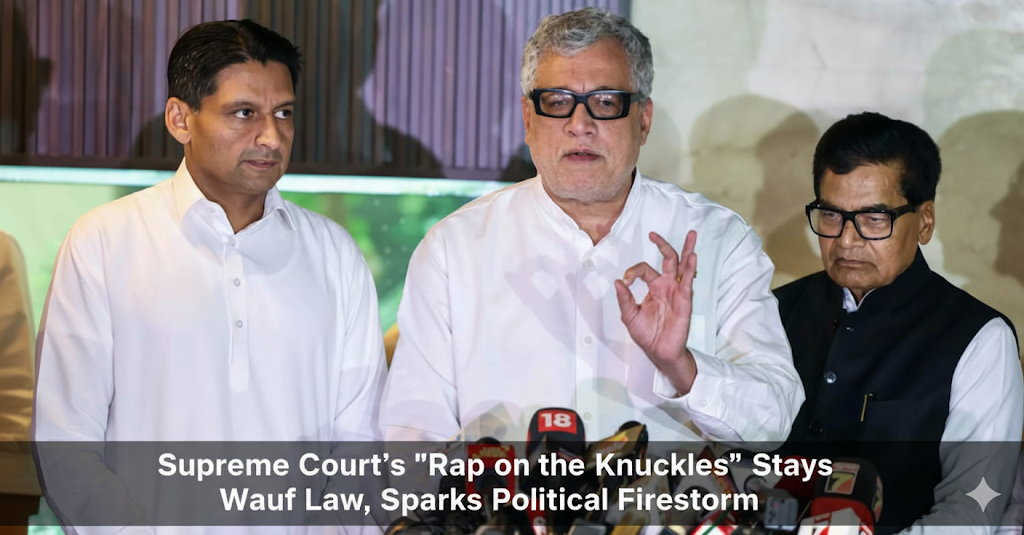
“More than a rap on the knuckles”: Derek O’Brien says SC stay on Waqf law is a full judicial rebuke
Supreme Court stays key parts of the Waqf Amendment Act — and TMC’s Derek O’Brien says the verdict exposes constitutional flaws and a parliamentary process that was treated like a rubber stamp.
What's Actually Going Down?
The Supreme Court has put a temporary hold on some important provisions of the Waqf Amendment Act after legal challenges questioned their validity. In response, Trinamool Congress MP Derek O’Brien called the stay “more than a rap on the knuckles” — a stinging rebuke he says points to deeper problems with the law’s constitutionality and the way it was pushed through Parliament. O’Brien also accused the government of mocking parliamentary procedure during the bill’s passage, raising alarms about laws aimed at minority-related institutions and the larger rule-of-law implications.
Here's the Tea
• Recent event: The Supreme Court has stayed certain provisions of the Waqf Amendment Act pending further hearings, effectively pausing parts of the law for now.
• Background context: The Waqf Amendment Act was touted as reform to the governance and oversight of Waqf institutions. But opponents said some changes could be unconstitutional or discriminatory, prompting petitions in the Supreme Court.
• Current situation: With the stay in place, those contested provisions cannot be enforced until the court decides the larger constitutional questions. Political heat is rising as opposition leaders, legal experts and civil-society groups weigh in.
Why Everyone's Talking About This
• Political drama: The timing and tone of the controversy feed into a broader narrative about governmental overreach and how Parliament functions — issues that could be politically toxic ahead of elections. Opposition parties smell leverage; the government faces questions about legislative consent and process.
• Real-world impact: Changes to Waqf administration affect how community properties and charitable trusts are managed — land records, revenue streams, legal control of properties used for social services and mosques. Any uncertainty can disrupt local governance, beneficiaries and faith-based institutions.
The Plot Thickens
• Short-term chaos: Administrative bodies and local Waqf boards are in limbo, unsure which rules now apply. Legal teams and bureaucracies will scramble to interpret the stay. Politically, expect an escalation of accusations in Parliament and on social media.
• Long-term game: If the Supreme Court ultimately strikes down parts of the law, it will be a major judicial check on the government’s legislative approach. That outcome could set precedent on how far Parliament can go in reforming community institutions without stronger constitutional footing.
What This Means for India
• Big picture: This is a textbook constitutional showdown — judiciary reining in legislative moves that are alleged to bypass rights or established procedure. It raises questions about minority protections, separation of powers, and the robustness of parliamentary debate.
• Bottom line: Ordinary Indians should care because the case touches on how laws impacting communities are made, enforced and challenged. When the legislative process is seen as hurried or opaque, trust in democratic institutions takes a hit.
The Real Talk
This isn’t just a legal wrangle over technical clauses. Derek O’Brien’s line — that the Supreme Court’s action is “more than a rap on the knuckles” — signals political consequences. The stay spotlights alleged procedural shortcuts and constitutional questions that will now be argued in public and in court. Watch for two parallel battles: legal arguments in the Supreme Court, and a political fight in Parliament and on the campaign trail. Both will shape how India handles sensitive reforms touching faith, property and governance.
What's Next?
• Will the government defend the Waqf Amendment aggressively in court, or recalibrate its approach to avoid a major judicial defeat?
• How will opposition parties use this moment in the run-up to state and national elections — can they convert legal controversy into political momentum?
• Does this ruling signal a wider reluctance by courts to allow sweeping legislative changes affecting minority institutions without airtight constitutional backing?


Comments