
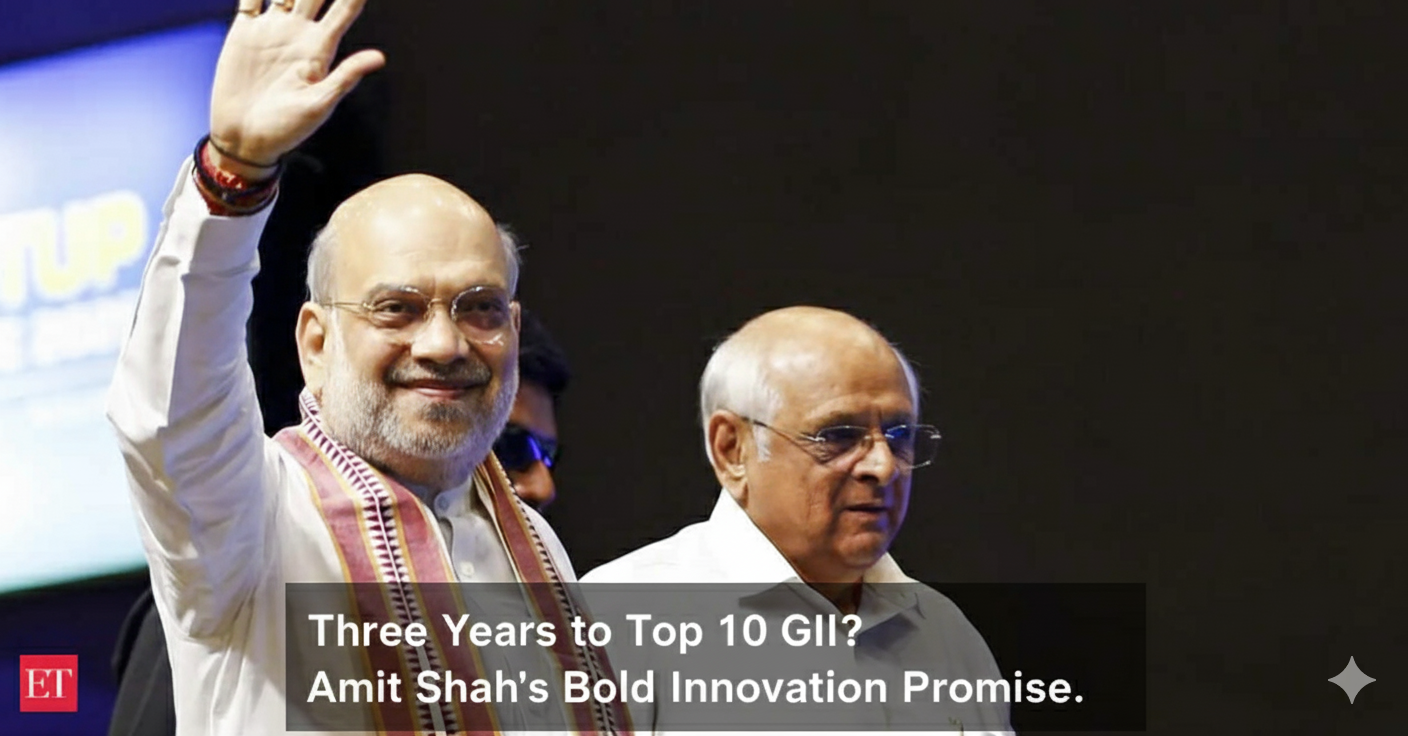
Amit Shah’s top‑10 GII claim — ambition or electoral rhetoric?
Home minister Amit Shah says India’s Global Innovation Index ranking has improved sharply and promises: “Give us three years — India will be in the top 10.” Is that realistic or just big talk?
What's Actually Happening?
At a recent event (reported by The Times of India), Amit Shah highlighted India’s rising performance on the Global Innovation Index (GII) and pointed to Startup India and other reforms as proof that India is sprinting up the innovation ladder. He declared confidence that India will break into the GII top 10 within three years — a bold deadline that has set off discussion among entrepreneurs, investors and policy watchers.
Here's the Breakdown
• Key development: Amit Shah publicly stated India’s GII rank has improved significantly and said India will be among the top 10 in three years, citing Startup India and the rising startup ecosystem (now the third largest globally).
• Background context: The Global Innovation Index (published by WIPO with INSEAD and Cornell) measures innovation using R&D, human capital, infrastructure, market sophistication, and business environment. India’s performance has steadily improved in recent years, driven by digital adoption, rising startup activity and targeted policy pushes.
• Current situation: India’s startup ecosystem is among the world’s largest and deep‑tech, pharma, defence, space and fintech are growth hotspots. But structural gaps—low R&D intensity, university‑industry links, and scale-up capital—remain hurdles to a rapid top‑10 leap.
Why This is Trending
• Primary impact: A top‑10 GII ranking would reframe India from a large market and services hub to a global innovation leader — attracting more capital, high‑end manufacturing and research partnerships.
• Public interest: The claim mixes politics and policy: it’s an ambitious growth narrative ahead of elections that speaks to jobs, national pride and the future of India’s startups — all hot topics for young professionals and investors.
The Bigger Picture
• Immediate effects: The statement instantly boosts investor sentiment and media attention on India’s innovation story — more VC interest, more startups pitching for scale, and states jockeying to showcase policies.
• Future implications: If backed by substantive policy and funding, a sustained push could shift India’s economic model toward higher value creation (deep tech, pharma R&D, semiconductors, advanced manufacturing). If not, the claim risks being dismissed as electoral rhetoric.
What This Means for You
• Direct impact: For founders and young professionals, more focus on innovation could mean easier access to incubation, targeted grants, and government procurement for startups — but also fiercer competition and higher expectations on outcomes.
• Bottom line: The promise is energising but conditional: real gains will depend on measurable investments in R&D, talent retention, regulatory clarity and predictable funding — not just slogans.
The Real Story
The headline — “India will be top 10 in GII in three years” — is a clear call to action and a political pitch. There’s real progress to build on: a booming startup ecosystem, stronger digital infrastructure, and pockets of world‑class research. But a top‑10 finish isn’t just PR; it needs heavy lifting on fundamentals: raise R&D intensity (India’s public + private R&D has historically lagged advanced economies), reform higher education, deepen linkages between labs and industry, scale risk capital beyond seed rounds, and speed up tech commercialisation. In short, ambition aligns with reality only if policy, money and institutions move in sync — and fast.
What's Coming Next?
• Watch for concrete targets from the Centre — new R&D budgets, mission‑mode programmes or state incentives to make the three‑year timeline credible.
• Expect heightened scrutiny from investors and analysts: they’ll look at patent trends, high‑tech exports, unicorn creation and R&D spend per GDP as the real scoreboard.
• Keep an eye on state governments and ministries (electronics, biotech, defence, education): their procurement and policy choices will determine whether the pledge turns into systemic change or remains a headline.


Comments